How to Check a Civil BOQ Before Issue
Use this workflow to trace each BOQ item back to its current source, test the calculation and record the review decision. It is written for site engineers, quantity surveyors and reviewers preparing a civil works quantity package.
Excel workbook (.xlsx), version 1.0. Start with Instructions, enter project items in BOQ Review, and use Summary to identify unfinished reviews. Worked Example contains fictional data.
Define the scope and current sources
Identify the package, location and cut-off date. Confirm which drawings, specifications, schedules and BOQ revisions form the review basis. Record the drawing number, revision, date, relevant sheet or detail, and where the source is held.
Keep a source register alongside the quantity package. Check that superseded drawings have been removed from the active takeoff set. When two sources disagree, record the conflict and the person responsible for resolving it before treating either interpretation as settled.
Check the limits between packages. Foundations, superstructure, finishes, services and external works often meet at shared interfaces. Record which item carries each part of the work so a quantity is counted once.
Read the BOQ item before measuring
Read the complete item description, preamble and specification together. Identify the material, grade or type, location, unit and stated inclusions. Record exclusions and any separate items that must be measured independently.
Enter the governing measurement document and its edition or clause where applicable. Apply the contract’s adopted rules for deductions, openings, laps, wastage and rounding. The checklist provides a calculation record. It does not choose a measurement standard for the project.
Resolve unit conflicts before comparing quantities. A volume in m³, surface area in m² and mass in kg describe different measurements. Converting one into another needs an explicit basis such as thickness, density or a verified schedule.
Trace the dimensions and calculation
For each item, record its location, dimensions, number of repeated elements and source references. Use explicit units. Avoid assuming that a typical detail applies to every floor, bay or location.
Identify deductions separately and record why each deduction applies. Check whether another BOQ item already includes the same work. Confirm whether a dimension is clear, overall, centre-line or net before using it.
Select the workbook’s calculation basis appropriate to the item and follow its Instructions. Treat measured totals from specialist schedules as source quantities with their own references. Check at least one row independently using a calculator or separate calculation.
Reconcile against the BOQ
Compare the independently calculated quantity with the BOQ quantity in the same unit and scope. This workbook defines variance as calculated quantity minus BOQ quantity. A negative variance means the calculated figure is lower.
Investigate differences before accepting them. Check source revisions, repeated elements, dimensions, deductions, unit conversions and scope boundaries. Record the cause and proposed correction, even where the numerical difference is small.
Review totals by unit and package. Adding metres, square metres, cubic metres and counts into one quantity total produces no meaningful measurement.
Worked example — fictional concrete bases
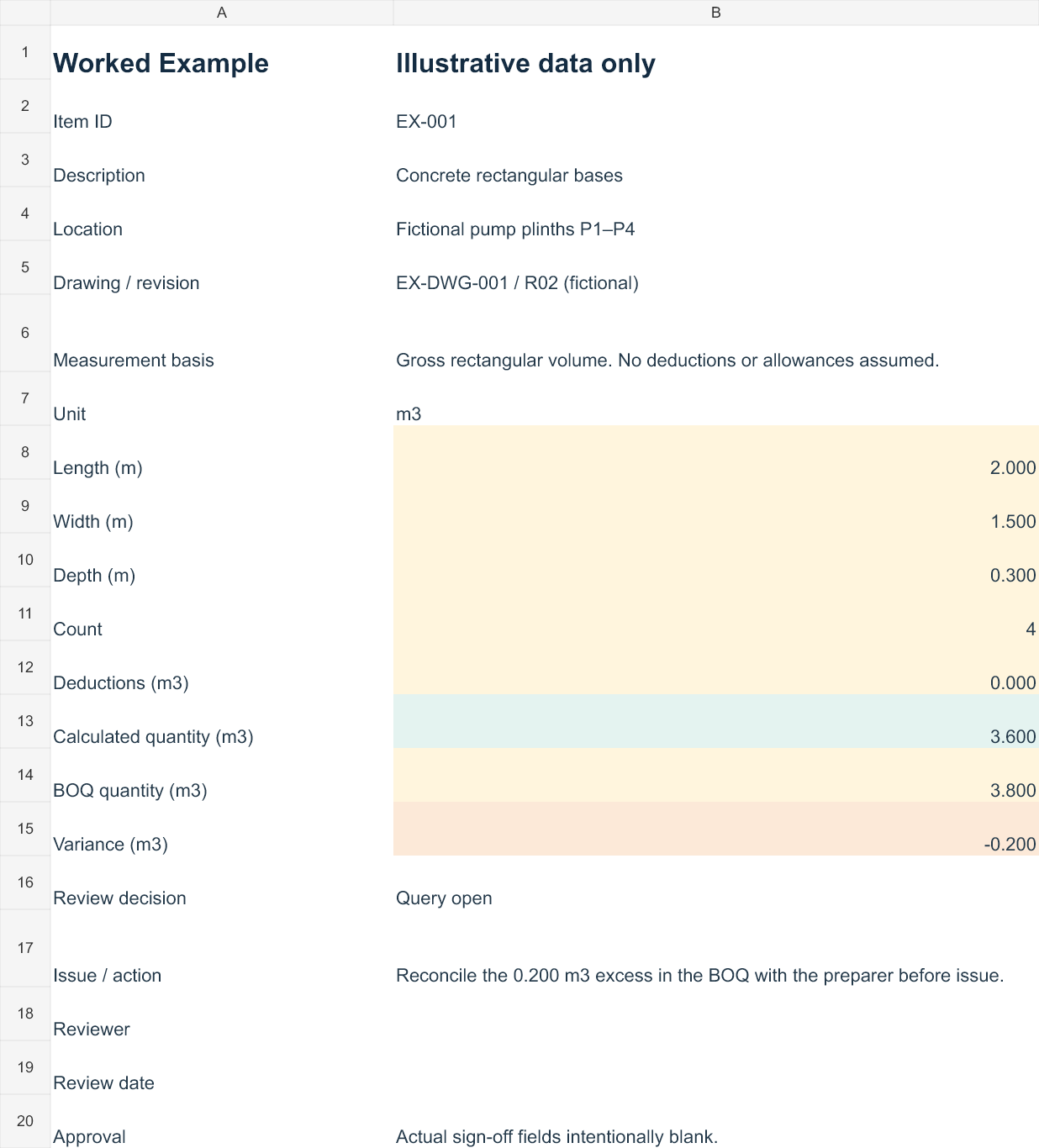
This recreated example is for learning. The illustrative source is EX-DWG-001, revision R02. It shows four identical rectangular concrete bases at fictional pump plinths P1–P4. Each base is 2.00 m long, 1.50 m wide and 0.30 m deep.
For this example only, the measurement basis is gross rectangular concrete volume. There are no openings or deductions, all four bases share the stated dimensions, and the comparison concerns concrete volume only. Reinforcement, formwork, excavation, blinding and wastage are outside this example. These are illustrative assumptions rather than a contractual measurement rule.
| Check | Illustrative value |
|---|---|
| Item | EX-001 · Rectangular concrete bases |
| Source | EX-DWG-001 / R02 |
| Calculation | 2.00 × 1.50 × 0.30 × 4 − 0.00 |
| Calculated quantity | 3.60 m³ |
| BOQ quantity | 3.80 m³ |
| Variance | −0.20 m³ |
The arithmetic gives 0.90 m³ per base and 3.60 m³ for four bases. The BOQ exceeds the calculated quantity by 0.20 m³. The proposed review decision is to raise a query asking whether the 3.80 m³ includes additional scope or a different source revision. Retain the item for review until the explanation or corrected quantity is recorded. Reviewer and review-date fields remain blank in the example.
Close discrepancies and record the review
Give each discrepancy a clear action, responsible person and supporting reference. State whether it concerns missing information, a quantity correction, a scope interpretation or an engineering decision. Use the status choices in the workbook deliberately. A populated formula, a zero result or a zero variance does not complete a review.
The reviewer should confirm the source revision, measurement basis, calculation, unit and reconciliation, then record their name and date when the review is actually performed. Record any outstanding technical approval separately. Correct arithmetic alone does not establish structural adequacy, constructability or approval to build.
Issue a usable quantity package
Before issue, reconcile the summary with the detailed rows, resolve or clearly identify open queries, check the issue revision and confirm the intended recipient. Include the takeoff basis, relevant source register and decision record so the next person can reproduce the quantity.
Adapt the workbook to the project’s contract, measurement rules and review process. Retain the previous issue and record changes. The example contains recreated data and carries no project sign-off.