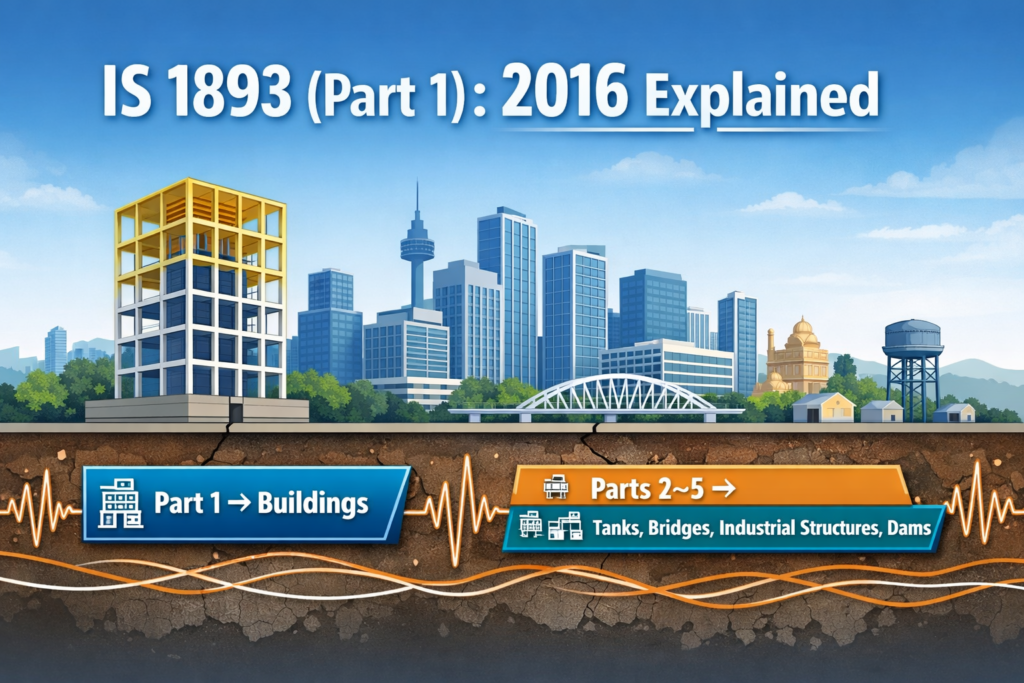
What the Code Covers
IS 1893 (Part 1): 2016 is the main earthquake design standard in the IS 1893 series for general seismic provisions and for buildings. Think of it as the foundation chapter: it gives the broad seismic framework for multiple structure types, and then gives the building-specific rules in detail.
1) Scope — what Part 1 actually covers
The code starts with a surprisingly broad umbrella. It says Part 1 primarily deals with earthquake hazard assessment for several kinds of structures, and it also deals specifically with the earthquake-resistant design of buildings.
General seismic scope
Part 1 is not just for buildings. It gives general seismic basis for:
- Buildings
- Liquid retaining structures
- Bridges
- Embankments and retaining walls
- Industrial and stack-like structures
- Concrete, masonry and earth dams
Building-specific design
After laying out the common seismic principles, Part 1 goes much deeper into the earthquake-resistant design of buildings. That is why the title is General Provisions and Buildings.
2) What structures it applies to
Clause 1 is wider than many students first assume. The code does not stop at ordinary building frames. It explicitly pulls in supporting and temporary works too — a neat little reminder that earthquakes do not politely ignore “minor” structures.
Main buildings
Residential, commercial, institutional and other buildings designed for seismic effects.
Ancillary structures
Parking structures, security cabins and ancillary structures also need seismic design.
Temporary elements
Scaffolding and temporary excavations are also brought under the code’s purview.
Critical and special structures
The code still applies, but its earthquake effects are treated as the minimum; extra studies may be required.
Practical reading of applicability
- Yes, buildings: this is the main detailed design portion of Part 1.
- Yes, support/ancillary works: do not casually exclude small site structures.
- Yes, temporary works: seismic design is not only for permanent glamorous concrete beasts.
- Yes, high-importance and special projects: but Part 1 is the floor, not the ceiling.
3) What Part 1 does not cover
Students often confuse design code provisions with construction detailing guides. Part 1 draws that line quite clearly.
Construction features are not fully covered here
Clause 1.4 says this standard does not deal with construction features relating to earthquake-resistant buildings and other structures.
You must read companion standards
The code directs the user to standards such as IS 4326, IS 13827, IS 13828, IS 13920, IS 13935 and IS 15988 for construction guidance, ductile detailing, repair and strengthening.
Advanced systems may need specialist literature
The Foreword notes that for base isolation and other advanced systems, specialist guidance may be needed until dedicated Indian standards are available.
4) How Part 1 connects with Parts 2 to 5
This is the central idea of the whole series. In the 2002 restructuring, IS 1893 was split into separate parts so each structural category could have more focused provisions. But Part 1 still remains the common seismic backbone.
The rule of reading the series
The Foreword says that Part 1 contains general provisions on earthquake hazard assessment applicable to all buildings and structures covered in Parts 2 to 5. It also states that, unless otherwise mentioned, Parts 2 to 5 are to be read in conjunction with the general provisions of Part 1.
| Part | Main topic | How it relates to Part 1 |
|---|---|---|
| Part 1 | General provisions and buildings | Base seismic framework for the whole series; detailed design provisions for buildings are given here. |
| Part 2 | Liquid retaining tanks | Use Part 2 for tank-specific rules, but read it together with the general seismic provisions of Part 1. |
| Part 3 | Bridges and retaining walls | Bridge/retaining-wall specifics are in Part 3; the common seismic basis still comes from Part 1. |
| Part 4 | Industrial structures including stack-like structures | Industrial behavior and stack-specific issues are in Part 4, read with Part 1 general provisions. |
| Part 5 | Dams and embankments | The Foreword notes Part 5 as to be formulated; Part 1 still identifies dams and embankments within the overall family scope. |
5) Find the right part quickly
Use this mini learning tool to understand where your structure sits in the IS 1893 family.
6) Why the series was split into parts
The Foreword explains the logic: by 2002, earthquake-resistant design had developed enough that different structural types needed their own focused provisions. One giant monolithic document would have become a lumbering paper dinosaur.
First publication
IS 1893 first appeared as recommendations for earthquake resistant design of structures.
Multiple revisions
The standard was revised repeatedly as knowledge and practice evolved.
Split into five parts
The committee separated the series into dedicated parts for different structural systems.
Current Part 1 edition
The sixth revision refines general provisions and building-specific seismic design.
7) Key takeaways for students
Exam-ready summary
- IS 1893 (Part 1): 2016 covers general seismic provisions and buildings.
- It gives the common hazard/design basis for structures handled in Parts 2 to 5.
- Parts 2 to 5 must generally be read together with Part 1.
- It applies not only to main structures but also to ancillary and temporary elements.
- For critical or special structures, code forces are the minimum; extra studies may be needed.
Conceptual summary
Part 1 is the gateway document of the IS 1893 family. It tells you the general seismic philosophy, basic applicability, and building design rules. Then the other parts zoom into special structure types without abandoning the common seismic foundation given here.
Part 1 = trunk
Parts 2–5 = branches