IS 1893
Seismic Weight — IS 1893 (Part 1): 2016 | Learning Resource
IS 1893 (Part 1): 2016 — Sixth Revision

Seismic Weight
What Counts and What Doesn’t

A comprehensive study guide on Clause 7.4 and Table 10 — understanding which loads are included in seismic weight calculations, which are excluded, and why this distinction is critical for earthquake-resistant design.

Clauses 3.26, 3.27, 7.4
Table 10 — % Imposed Load
Interactive Calculator
Submission Report Generator
01

Why Seismic Weight Matters

When an earthquake strikes, a building doesn’t “feel” all of the loads it normally carries. Newton’s second law tells us that seismic force equals mass × acceleration. So the key question is: whose mass generates inertia forces during ground shaking?

IS 1893 (Part 1): 2016 answers this precisely through Clause 7.4 and Table 10. The seismic weight is not the full working load — it is a carefully defined combination of permanent (dead) loads and only a fraction of live (imposed) loads. Getting this wrong directly affects the computed base shear, and thus the safety of the entire design.

Design Seismic Base Shear [Clause 7.2.1]
VB = Ah × W
VBDesign seismic base shear (kN) AhDesign horizontal acceleration coefficient = Z/2 × I/R × Sa/g WSeismic weight of the building (kN) — defined by Clause 7.4
💡
Key Insight: A larger seismic weight W means a larger base shear VB, meaning more lateral force on columns, beams, and foundations. Therefore, understanding exactly what contributes to W is fundamental to both safety and economy of design.
02

Key Definitions from IS 1893

Clause 3.26 — IS 1893 (Part 1): 2016
Seismic Weight of a Floor (Wf)

It is the sum of dead load of the floor, appropriate contributions of weights of columns, walls and any other permanent elements from the storeys above and below, finishes, services, and appropriate amounts of specified imposed load on the floor.

Clause 3.27 — IS 1893 (Part 1): 2016
Seismic Weight of a Structure (W)

It is the sum of seismic weights of all floors. This is the total W that enters the base shear formula.

Clause 3.24 — IS 1893 (Part 1): 2016
Seismic Mass of a Floor

It is the seismic weight of the floor divided by acceleration due to gravity (g = 9.81 m/s²). Mass (kg or tonnes) = Weight (N or kN) / g.

🔗 Relationship Between These Terms

The hierarchy is: Seismic Weight of a Floor → Sum for all floors → Seismic Weight of Structure → Used in VB = Ah × W.

When computing the seismic weight of each floor, the weight of columns and walls in any storey shall be apportioned to the floors above and below — typically 50% to each adjacent floor, unless otherwise specified.

03

Clause 7.4 — Seismic Weight: Full Breakdown

7.4.1 — Seismic Weight of Each Floor

The seismic weight of each floor is its full dead load plus appropriate amount of imposed load. While computing the seismic weight of each floor, the weight of columns and walls in any storey shall be appropriately apportioned to the floors above and below the storey.

Clause 7.4.2 specifies: any imposed load contribution on roof need not be included.

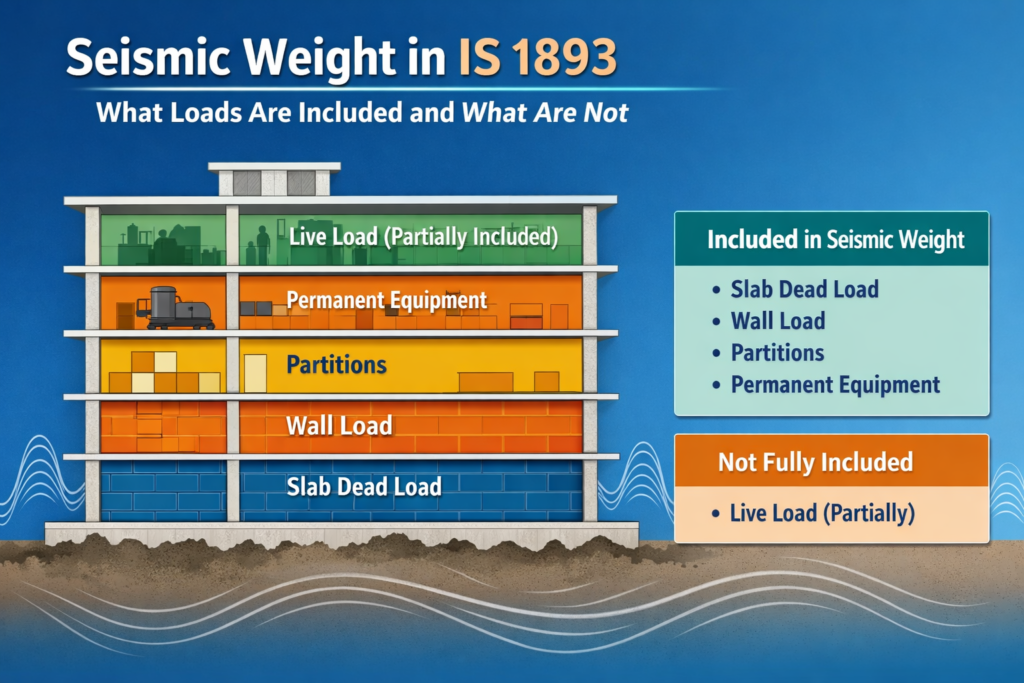
✅ Loads INCLUDED in Seismic Weight
Dead Load (DL) — 100% Self-weight of structural members (slabs, beams, columns, walls), permanent partitions, flooring, cladding.
Finishes — 100% Weight of floor finishes, screed, tiles, false ceilings that are permanent fixtures.
Services — 100% Permanent MEP services, water tanks, HVAC equipment permanently fixed to the structure.
Imposed Load (IL) — 25% if IL ≤ 3 kN/m² As per Table 10 of IS 1893. Residential floors, offices with light storage.
Imposed Load (IL) — 50% if IL > 3 kN/m² As per Table 10. Warehouses, storage floors, assembly areas with high occupancy.
Weight of water tanks / liquid stores Full weight of water is permanent and always present — 100% included.
Half wall/column weight from adjacent storeys 50% weight of columns/walls between floors above and below are attributed to each floor.
❌ Loads EXCLUDED from Seismic Weight
Full Imposed Load Only a fraction (25% or 50%) of imposed load is included — not the full value. The rest is excluded.
Imposed Load on Roof — 100% excluded Per Clause 7.4.2: For calculating seismic weight of the building, the imposed load on the roof shall NOT be included.
Wind Load Wind is a lateral load independent of seismic analysis. It is not included in seismic weight W.
Snow Load (generally) Excluded unless specifically required. Earthquake and maximum snow do not co-occur (Clause 6.2b).
Impact and Dynamic Loads Crane impact, machine dynamic loads — these are separately assessed and not part of seismic mass.
Hydrostatic Loads (external) Lateral earth pressure, water pressure on basement walls — excluded from seismic weight W.
⚠️
Common Student Mistake: Students often add the full imposed load to the dead load when computing W. IS 1893 Clause 7.4 and Table 10 require only a percentage (25% or 50% depending on magnitude). Always check the imposed load intensity first before choosing the multiplier.
04

Table 10 — Imposed Load Percentage

Table 10 — Percentage of Imposed Load to Be Considered for Seismic Weight Calculation
IS 1893 (Part 1): 2016 — Clause 7.4.2
Sl. No. Imposed Uniformly Distributed Floor Load (kN/m²) Percentage of Imposed Load to be Considered
(1) Up to and including 3.0 kN/m² 25%
(2) Above 3.0 kN/m² 50%
📌 Note: The imposed load on the roof need not be considered when calculating seismic weight of a structure (Clause 7.4.2). For calculating seismic weight of each floor, the imposed load shall be as given above.

Practical Application of Table 10

The key threshold is 3 kN/m². Here’s how it works in practice:

IL ≤ 3.0 kN/m² → 25%
Light Occupancy

Residential buildings (2 kN/m²), offices (3 kN/m²), corridors in houses, bedrooms

IL > 3.0 kN/m² → 50%
Heavy Occupancy

Warehouses (5–10 kN/m²), storage facilities, assembly halls, manufacturing areas

🎯
Why only a fraction? The rationale is probabilistic. It is unlikely that the full imposed load will be present on all floors simultaneously during an earthquake. The fraction accounts for the statistical reality of partial occupancy at the time of the earthquake.
05

Step-by-Step Calculation Method

  1. 1
    Identify the Floor Area and Dead Load

    Calculate the self-weight of slabs, beams, columns, walls, finishes, and permanent fixtures at each floor. This is your full dead load (DL) in kN/m² or kN total.

  2. 2
    Determine the Imposed Load Category

    Identify the imposed (live) load intensity per IS 875 Part 2 for the occupancy type. Compare with 3 kN/m² threshold from Table 10.

  3. 3
    Apply the Table 10 Percentage

    If IL ≤ 3 kN/m²: take 25% of IL. If IL > 3 kN/m²: take 50% of IL. For the roof: take 0% of IL.

  4. 4
    Compute Seismic Weight of Each Floor (Wi)

    Wi = DLi + λ × ILi where λ = 0 (roof), 0.25 (IL ≤ 3), or 0.50 (IL > 3)

  5. 5
    Apportion Column/Wall Weights

    Add half the weight of columns and walls from the storey below and half from the storey above to each floor’s Wi. Typically, structural software handles this automatically.

  6. 6
    Sum to Get Total Seismic Weight (W)

    W = ΣWi for all floors. This is the seismic weight of the entire structure used in VB = Ah × W.

Seismic Weight per Floor [Clause 7.4.2 + Table 10]
Wi = DLi + λ × ILi
WiSeismic weight of floor i (kN) DLiTotal dead load at floor i (self-weight + finishes + permanent loads) λ= 0 for roof | = 0.25 if IL ≤ 3 kN/m² | = 0.50 if IL > 3 kN/m² ILiTotal imposed load at floor i (kN)
06

Visual: Weight Distribution Across Floors

ROOF — IL excluded (0%) DL (100%) 25% Floor 4 IL≤3 DL (100%) 25% Floor 3 IL≤3 DL (100%) 50% Floor 2 IL>3 DL (100%) 50% Floor 1 IL>3 Dead Load (100%) Imposed Load (25% or 50%)

Illustrative 4-storey building — proportional bar shows dead load (blue) vs imposed load contribution (amber) to seismic weight per floor

07

Interactive Seismic Weight Calculator

🏗️

Seismic Weight Calculator — IS 1893 (Part 1): 2016

Clause 7.4 + Table 10 — Enter floor data to compute W per floor and total seismic weight W

Project / Building Name
Seismic Zone Table 3
Importance Factor (I) Cl. 6.4.2
Response Reduction Factor (R) Cl. 6.4.2
Sa/g (Response Accel. Coeff.) Cl. 6.4.2
From Fig. 2 for T and soil type (typical: 2.5 for short period)
Floor Area (m²) all floors same
Plan area of each floor in m²
Floor Data Table 10 applied automatically
Floor
Floor Type
Dead Load (kN/m²)
Imposed Load (kN/m²)
λ Used
📊 Calculation Results — IS 1893 (Part 1): 2016
Total Seismic Weight W
Design Coeff. Ah
Base Shear VB
Total Dead Load
Total IL Contribution
IL as % of W
Floor DL (kN) IL Total (kN) λ IL Used (kN) Wi (kN)
Interpretation will appear here after calculation.
08

Self-Assessment Quiz

Q1 According to IS 1893 Clause 7.4, what percentage of imposed load is included in seismic weight when the imposed load intensity is exactly 3.0 kN/m²?
a) 50%
b) 25%
c) 100%
d) 0%
Q2 Which of the following loads is completely excluded from seismic weight computation as per IS 1893?
a) Imposed load on roof
b) Weight of permanent partitions
c) Self-weight of columns
d) Weight of services
Q3 A warehouse floor has an imposed load of 7.5 kN/m². What percentage of this imposed load is considered in seismic weight as per Table 10?
a) 25%
b) 100%
c) 50%
d) 75%
Q4 The seismic weight of a structure is defined in IS 1893 as:
a) Sum of all dead loads and full imposed loads of all floors
b) Sum of seismic weights of all floors
c) Sum of dead loads only from all floors
d) Total live load of the building
Q5 In the base shear formula VB = Ah × W, the design horizontal acceleration coefficient Ah is expressed as:
a) (Z/2) × (I/R) × (Sa/g)
b) Z × I × R × Sa/g
c) (Z × I) / (2 × R × Sa)
d) Z / (2 × I × R)
09

Key Takeaways

⭐ Summary — Seismic Weight in IS 1893

  • Seismic weight W is defined in Clause 7.4 and directly governs the design base shear VB = Ah × W.
  • Dead loads (structural weight, finishes, services) are included at 100% in W for all floors.
  • Imposed loads contribute only partially: 25% if ≤ 3 kN/m², 50% if > 3 kN/m² — per Table 10.
  • The imposed load on the roof is completely excluded from seismic weight (Clause 7.4.2).
  • Wind load, impact loads, snow load, and hydrostatic loads are NOT part of seismic weight W.
  • Column and wall weights are apportioned 50-50 to the floors above and below each storey.
  • The partial inclusion of imposed loads is justified by the low probability of full occupancy during an earthquake.
  • Total W = ΣWi for all floors, and is used in both equivalent static and dynamic analysis methods.

🔴
Exam Alert: Questions on seismic weight frequently ask you to identify which loads are excluded. The most tested points are: (1) roof imposed load = 0% included, (2) wind and snow not counted, (3) Table 10 boundary at exactly 3 kN/m².

📚 Reference Clauses Quick Index

3.26 Seismic Weight of a Floor
3.27 Seismic Weight of a Structure
7.4.1 Computation of W per floor
7.4.2 Table 10 — IL percentage
Table 10 25% / 50% rule for IL
6.4.2 Ah = Z/2 × I/R × Sa/g
7.2.1 Base Shear VB = Ah × W
6.2b Earthquake + max snow ≠ simultaneous

Leave a Comment